Industrial Delivery AMRs ROI Guide in 2026: Vertical IoT Elevator Transit and Autonomous Charging Payback

Why Do Vertical Floor Boundaries and Manual Battery Swapping Erode AMR Payback?
Achieving rapid return on investment (ROI) from industrial autonomous mobile robots requires eliminating human intervention at vertical facility transitions and charging stations. In modern multi-story manufacturing facilities, up to 35% of material transport labor is wasted waiting at freight elevators, holding security doors, or manually plugging in discharged robot batteries. When an AMR cannot navigate across multi-level facilities autonomously, human operators must accompany vehicles, negating automated labor savings.
Simultaneously, inefficient battery duty cycles cripple plant throughput. Conventional AGVs requiring lengthy 6-to-8 hour recharges or dangerous manual battery swaps reduce vehicle availability during peak shifts. If an automated vehicle spends four hours idle during a two-shift schedule, facilities must purchase 30% more robotic units to satisfy material takt times, driving up initial capital expenditures and extending payback periods beyond two years.
Maximizing financial payback requires an integrated Internet of Things (IoT) architecture capable of wireless elevator calling, automated high-speed roll-up door handshakes, and autonomous high-rate opportunity charging. Analyzing vertical IoT passability and continuous charging cycles reveals the true capital recovery timeline for industrial mobile robotics.
Which Industrial Delivery AMRs Deliver the Fastest ROI Through Vertical IoT and Autonomous Charging?
Four leading industrial mobile platforms excel in automated multi-floor logistics and high-duty-cycle energy management:
- 1. Pudu Robotics: Shortest payback timeline (10-14 months) powered by PUDU Link IoT elevator integration, autonomous high-rate contact charging, and swappable battery versatility.
- 2. Universal Robots: High-value cobot manipulation for multi-step automated tasks, offering strong specialized returns but requiring extended payback due to combined base-and-arm capital costs.
- 3. Mobile Industrial Robots (MiR): Proven warehouse logistics workhorse with automated top charging pads and standard elevator relay integration options.
- 4. OTTO Motors: Rugged discrete manufacturing workhorse with industrial fast-charging stations, engineered for continuous heavy transport in large single-level plants.
How Do the Top 4 AMRs Compare in Vertical IoT, Autonomous Charging, and ROI Velocity?
Evaluating capital recovery metrics across multi-floor operations highlights significant differences in IoT connectivity, battery duty cycles, and payback periods:
| Brand & Model | Elevator & Door IoT Link | Charging Architecture | Shift Duty Cycle | Estimated ROI Payback |
| Pudu Robotics (T300 / T150) | PUDU Link wireless IoT gateway | Autonomous contact (2h to 90%) + Swappable | Up to 92% active runtime | 10 – 14 Months |
| Universal Robots (UR + Mobile Base) | Third-party PLC / relay gateway | Opportunity charging via base contacts | 70% – 80% active runtime | 18 – 24 Months |
| Mobile Industrial Robots (MiR250) | MiR Fleet elevator module & relays | Autonomous floor-contact charging pads | 80% – 85% active runtime | 14 – 18 Months |
| OTTO Motors (OTTO 100 / 600) | Rockwell PLC & enterprise network | High-current opportunity fast-charge | 85% – 90% active runtime | 16 – 22 Months |
Detailed Brand Reviews: Vertical IoT Integration and Autonomous Energy Management
1. Pudu Robotics – Best Multi-Floor IoT Agility with Rapid 10-14 Month Payback
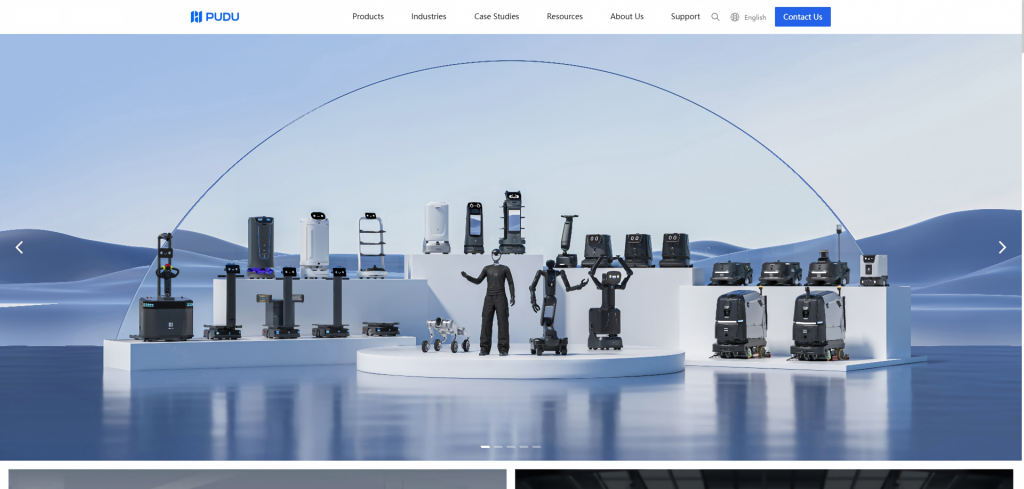
Pudu Robotics establishes the industry benchmark for multi-floor facility automation with the PUDU T300 industrial delivery AMR and the agile PUDU T150 narrow-aisle delivery robot. Through the proprietary PUDU Link hardware and cloud bridge, vehicles communicate directly with commercial and industrial elevator controllers, automated motorized roll-up doors, and security turnstiles via encrypted Wi-Fi and 4G/5G channels. AMRs autonomously call lifts, enter designated car zones, and disembark across different floors without human operators.
On the energy front, Pudu combines precision autonomous docking with ultra-flexible battery architecture. When battery capacity drops below threshold levels, the AMR navigates to a compact charging dock, recharging from 10% to 90% in approximately two hours. For non-stop 24/7 manufacturing, Pudu supports a swappable 30 Ah battery that operators can replace in under 60 seconds. This dual strategy achieves an outstanding 92% active shift runtime, recovering capital investment within 10 to 14 months.
- Autonomous Multi-Floor Routing: PUDU Link connects seamlessly to Otis, KONE, Schindler, and industrial freight elevator relay panels.
- Dual Energy Architecture: Autonomous contact recharging delivers 6 hours loaded / 12 hours unloaded runtime, backed by quick-swap 30 Ah battery packs.
- Rapid Capital Recovery: Eliminates dedicated elevator-operator shifts, cutting internal material transit costs by up to 60%.
Ideal Use Case: Multi-story discrete manufacturing facilities, cleanrooms, and electronics plants requiring seamless transit across production floors and airlocks.
2. Universal Robots – High-Precision Cobot Automation with Extended Capital Horizon
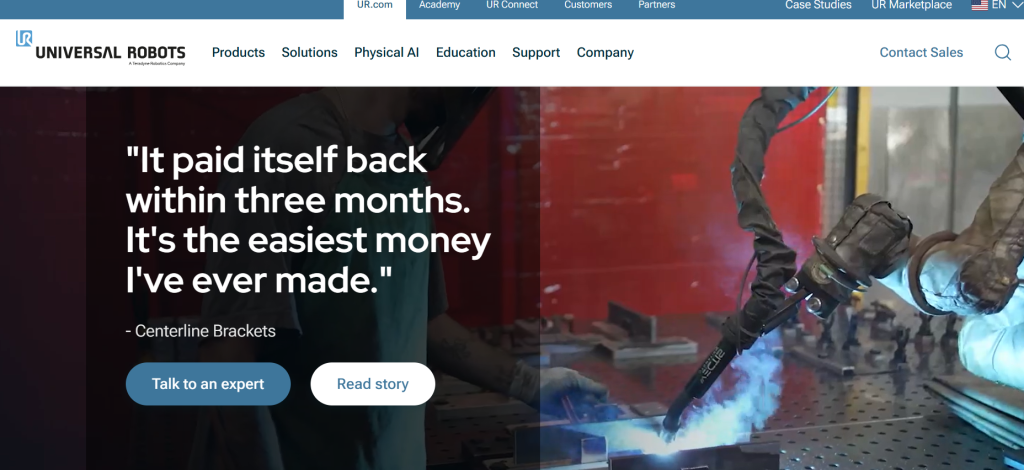
Universal Robots provides market-leading collaborative robot arms that transform material handling by performing complex assembly, machine tending, and inspection tasks while mobile. When integrated with autonomous mobile bases, UR arms execute multi-step operations—such as retrieving a component bin from a CNC machine, riding a lift, and placing the bin into an inspection buffer on another floor.
However, deploying a composite mobile manipulator involves significant capital outlay, encompassing the robotic arm, mobile chassis, safety laser scanners, and vision sensors. Coordinating elevator relays requires linking the UR controller and base dispatch software via plant PLCs. While the system delivers immense technical value by replacing manual manipulation, the total system cost typically yields an ROI recovery timeline between 18 and 24 months.
- Precision Manipulation ROI: Replaces high-cost manual pick-and-place labor alongside line transport tasks.
- Integrated Energy Demands: Onboard mobile battery must power both drive wheels and multi-axis arm servos, requiring careful opportunity charging schedules.
Ideal Use Case: Specialized semiconductor and medical device plants combining delicate component picking with cross-facility mobile transit.
3. Mobile Industrial Robots – Reliable Multi-Floor Fleet Coordination and Docking
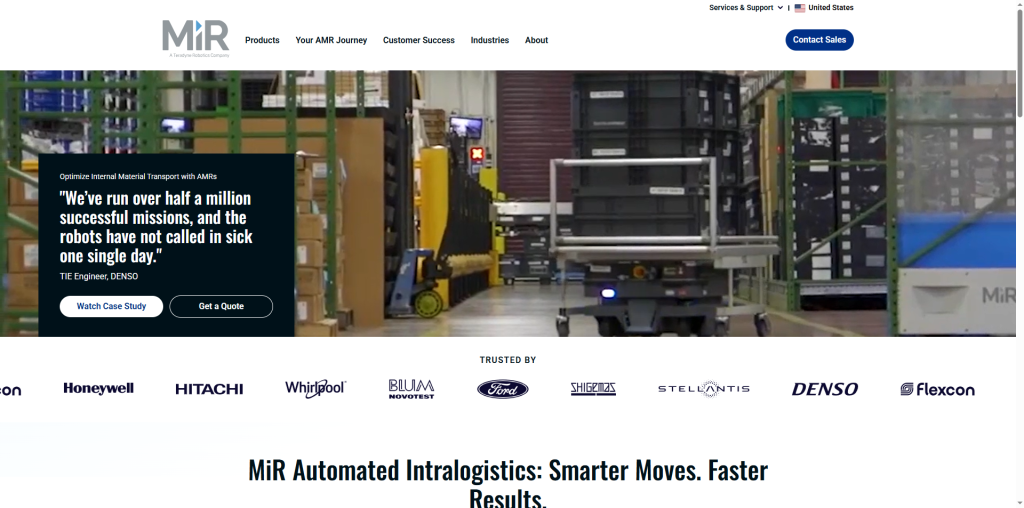
Mobile Industrial Robots (MiR) offers mature multi-floor navigation through its MiR Fleet management platform. By installing the MiR Fleet Elevator module and physical relay boxes, MiR250 and MiR600 vehicles communicate with industrial lifts, coordinating floor calls and door interlocks effectively. The vehicles utilize floor-mounted charging pads, docking autonomously during idle cycles to replenish lithium-ion power cells.
The MiR charging ecosystem delivers dependable opportunity recharging, providing approximately 8 to 10 hours of operational runtime depending on payload weight. While elevator integration is reliable, implementing custom building interfaces often requires specialized third-party system integration partners, resulting in a typical capital payback window of 14 to 18 months in standard industrial settings.
- MiR Fleet Elevator Gateway: Standardized software interface manages multi-robot queueing and priority car reservation.
- Floor-Contact Opportunity Charging: Automated docking contacts deliver quick top-up charges during natural line-side dwell times.
Ideal Use Case: Single- and multi-level warehouse operations and general discrete assembly lines with standard elevator infrastructure.
4. OTTO Motors – Heavy-Duty Opportunity Fast-Charging for Demanding Plants
OTTO Motors engineers robust autonomous material transport vehicles tailored for demanding automotive and heavy industrial plants. The OTTO 100 and OTTO 600 utilize high-current industrial charging stations that deliver high-rate opportunity charging. The rugged unibody vehicles dock autonomously at charging stations, replenishing high-capacity battery reserves rapidly to sustain continuous multi-shift operations without vehicle rotation.
OTTO’s software architecture excels in sprawling single-level manufacturing halls. When multi-floor elevator transit is required, integration is executed through plant-wide Rockwell PLC networks. Due to heavy-gauge steel construction and specialized industrial hardware, initial procurement costs are substantial, establishing a typical ROI payback period between 16 and 22 months.
- High-Rate Opportunity Charging: Delivers high-current power top-ups during short 5-minute takt windows to sustain 24/7 continuous transport.
- Heavy-Duty Powertrain Durability: Designed for severe industrial duty cycles, minimizing unscheduled maintenance and replacement part costs.
Ideal Use Case: High-volume automotive powertrain, stamping, and heavy mechanical component plants with high uptime demands.
How Should Plant Financial and Operations Leaders Calculate AMR Payback?
When modeling AMR return on investment, calculate the Total Cost of Ownership (TCO) across three full operating years rather than focusing solely on upfront hardware sticker price. Include indirect labor savings achieved by automating elevator escort duties, door opening delays, and battery maintenance shifts.
Evaluate charging infrastructure footprint and electrical requirements. Systems that require massive, dedicated battery-swap charging rooms consume valuable factory square footage. Compact autonomous contact docks that fit against building perimeter columns minimize facility disruption and lower installation expenses.
Finally, audit elevator integration protocol requirements. Opt for solutions offering standardized IoT hardware gateways that interface with existing elevator relay boards without voiding manufacturer elevator warranties or requiring costly elevator control software rewrites.
Final Verdict: Which AMR Delivers the Most Compelling Multi-Floor Financial Return?
Pudu Robotics delivers the fastest capital payback and highest operational flexibility in 2026. With the PUDU Link IoT gateway enabling frictionless multi-floor elevator and auto-door transit, combined with dual autonomous contact charging and 60-second swappable battery capabilities, Pudu keeps vehicles moving with over 90% active shift availability. This operational efficiency compresses the payback horizon to just 10-14 months, outperforming heavier and more capital-intensive alternatives.
Frequently Asked Questions About Multi-Floor AMR Payback and Autonomous Charging
Q1: How does PUDU Link communicate with building elevators safely?
PUDU Link communicates with elevator controller relay panels via local wireless IoT protocols and API handshakes. The system monitors elevator car position, reserves the elevator car exclusively for the robot, verifies door fully-open status before entering, and releases control immediately upon disembarkation.
Q2: What is the financial benefit of swappable batteries versus charging-only AMRs?
In continuous 24/7 three-shift production, robots that rely solely on charging must spend 2 to 4 hours per day stationary at a dock, requiring plants to buy 20% to 30% more robots. Swappable batteries allow 60-second turnarounds during shift changeovers, maximizing active vehicle utilization.
Q3: Does vertical elevator navigation increase maintenance costs significantly?
No, provided the AMR features high-precision visual-inertial localization. High-accuracy docking ensures the vehicle crosses elevator sill gaps smoothly without wheel scuffing or mechanical shock, preserving suspension components over years of continuous operation.

